
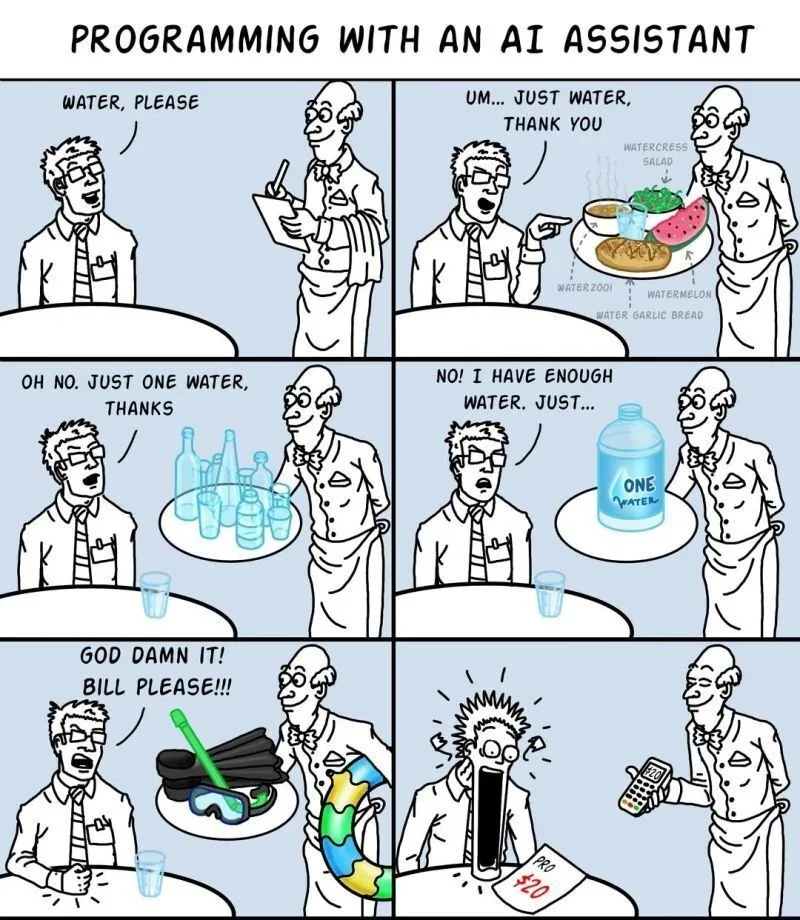
Programming and software development has become something of a joke in 2026.
The bottleneck in pushing features and squashing bugs historically has been the intelligence of the software developer. It takes a certain amount of time to do work, check it and get it reviewed (and make any necessary changes). You’d need to think through requirements, design solutions, write code, debug issues and deal with someone shouting about something personal in your open plan office. It’s all gone now.
Now the bottleneck is trying to stop AI from enthusiastically solving problems nobody actually has.
The Situation
You ask for a small helper function and suddenly you’ve got:
4 new abstractions
a caching layer
3 design patterns
unit tests
a Docker setup
Kafka integration
comments explaining what an if statement does
Sometimes you’ve let an agent run wild on your codebase and it suddenly decides that half your codebase should somehow be TypeScript.
The frightening part is no matter what craziness gets implemented, it all seems reasonable. All the tests pass. Then it successfully passes code review and gets put into production.
“It’s a trap”
The Productivity Lie
In my company we have been told that due to AI we need to code 5x faster as a minimum requirement (although it is not clear what the baseline for that 5x is, or what we need to do 5x faster).
Some of us are generating features in minutes that previously would have taken a day, or longer. Some of us have multiple Claude windows running at once, solving different problems in different parts of the codebase simultaneously.
Then then we look at our code.
Duplication of business logic
“Interesting” architecture choices
Accessibility broken
State accessible across the piece
New safety concerns that nobody previously needed to worry about
So yes, the typing is faster. The thinking is sometimes absent entirely in this new world.
Programming was never about typing speed, and optimising that is causing problems of its own. Because we never measured WPM in interviews, your typing strategy never commented on during performance reviews.
We should know that there is real value in senior engineers.
Trade-offs. Spotting hidden complexity. Identifying edge cases. Knowing when to say no. Understanding when something shouldn’t be built at all.
Because an AI super-coder always seems to have the same kryptonite. It never knows when something should not be built at all. Yet that makes sense when software companies themselves are remarkably bad at restraint.
AI Generates Confidence Faster Than Competence
AI just wants to make us happy. It wants to make us happy about the code we’ve written even if it has been written by a previous session of the same large language model. So no wonder it passes code as appropriate of clever when it is neither.
Add to this bad code gets passed into production because it simply looks good (LGTM!). That’s because bad code used to look bad, rather than the current mess of beautifully formatted nonsense.
The days of poor naming and rubbish indentation are gone. Confident comments are added to code that won’t even compile. The architecture becomes chaos.
Software developers seem satisfied of doing the equivalent of combining paragraphs from unrelated Wikipedia articles and calling it an essay. At the same time reviewers are looking at individual paragraphs and saying LGTM! as the polish is there, although the correctness is sadly lacking.
The Real Skill?
We should be able to pull the gold out of the mine at this point. We need to develop judgement, and to understand what really needs to be done and how to deliver it.
So my question to you is: why is the opposite happens?
Conclusion
We are moving to a world where we want engineers to do more and more, faster and faster.
When we really want the most valuable engineers who are capable of:
identifying bad outputs
simplifying systems
verifying correctness
understanding product implications
and controlling complexity
In other words:
the exact things many companies stopped training people to do years ago.
Which is unfortunate timing, don’t you think?
About The Author
Professional Software Developer “The Secret Developer” can be found on Twitter @TheSDeveloper and regularly publishes articles through Medium.com
The Secret Developer suspects half of modern software engineering is now convincing AI not to create another micro-service.