
My Code Pays the Bills
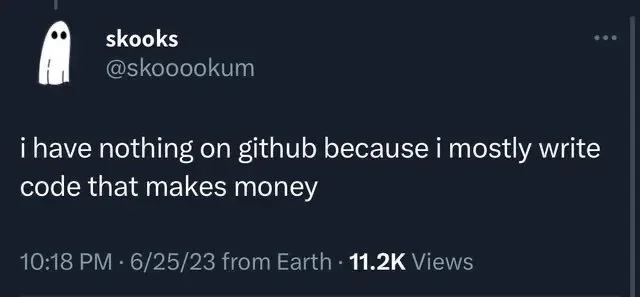
I’m a fully paid-up software developer these days, and (as strange as it sounds) I hope it stays this way. I spend whole days writing (okay, getting Claude to write) code and deploying to services (which are then often broken). Good times!
So one of the last things I want to do after spending all week writing software is to go home and write software.
If you’re not paying me, then I’m not that interested in software development.
This means it’s getting tricky to prove my worth in interviews or to other developers. Because it seems that I should be working in my spare time to prove my worth as a developer, say other developer. Typical judgement there, then.
Show Me Your Money (GitHub)
Sure, employers like GitHub profiles as they are a convenient and quick way to see if developers are worth pursuing in the job market.
Instead of merely believing that someone who has been professionally employed to write software might actually be able to write software, you can look through their public repositories.
Great! Everyone wins!
Yet there is an obvious problem. Nobody technical in the interview process reads a candidate’s resume, let alone any of the code they have written (unless perhaps they have been asked to write a take-home test). Recruiters parse this stuff and don’t actually know how to rate it, and the technical staff behind the scenes do not want to read it meaning nobody reads the code.
There again, I’ve been writing code for decades now and nobody ever reads any of it! Because that’s the world of commercial software in 2026.
Perhaps the solution to this is to upload my commercial project to GitHub. I suspect my previous employers might have something to say about that, but that said someone used Claude with the — dangerously-skip-permissions flag and watched with horror as Claude uploaded commercial code to a public repo. So there is precedent
The Invisible Developer
It’s a crazy situation, without the use of cigarettes and alcohol. It’s not fair and puts some of us into an invisible state.
Let us compare two developers.
Developer A works all day on complicated commercial systems. They solve production problems, review other people’s code, negotiate requirements, deal with legacy systems and somehow survive meetings about meetings.
At 5 PM, they close their laptop.
Developer B spends evenings and weekends maintaining public projects. Their GitHub contribution graph is a beautiful shade of green.
I’ll give you a minute to think about this.
The answer? We don’t have enough information to answer the question. Yet recruitment coordinators (who?) will ask for your GitHub profile at the very first opportunity, and will take that opportunity to weed you out of the process if they can.
So if you don’t have a side project, if you don’t contribute to an open-source project or can’t prove you code at the weekend? I guess saying you went outside is not enough, is it?
The Passion Problem
I actually think you need to enjoy software development to become really good at it.
I’ve yet to hear about a dentist being rejected because their public profile showed an alarming lack of recreational dentistry.
So how come we ended up with an industry that is so skewed?
It’s back to one of the classics. It’s back to poor management and interview processes.
You’re hearing from somebody who has previously spent significant amounts of time preparing data structures and algorithms for interviews. In one interview, I ended up sitting there unable to remember the implementation details of a heap while the interviewers watched me fail to remember them for 20 minutes. I mean sitting staring at each other.
What Actually Matters
The most valuable code I’ve written professionally isn’t sitting in a public repository with my name attached to it. Which is the point of professional software development.
Companies pay developers to solve their problems.
The interesting questions are what problems you’ve solved, how you approached them, what you learned when things went wrong and whether you can work effectively with other people.
Perhaps we should measure that?
About The Author
Professional Software Developer “The Secret Developer” can be found on Twitter @TheSDeveloper.
The Secret Developer would like to make more money to pay the bills.