
Stack Overflow Is Dying. Long Live… Whatever This Is
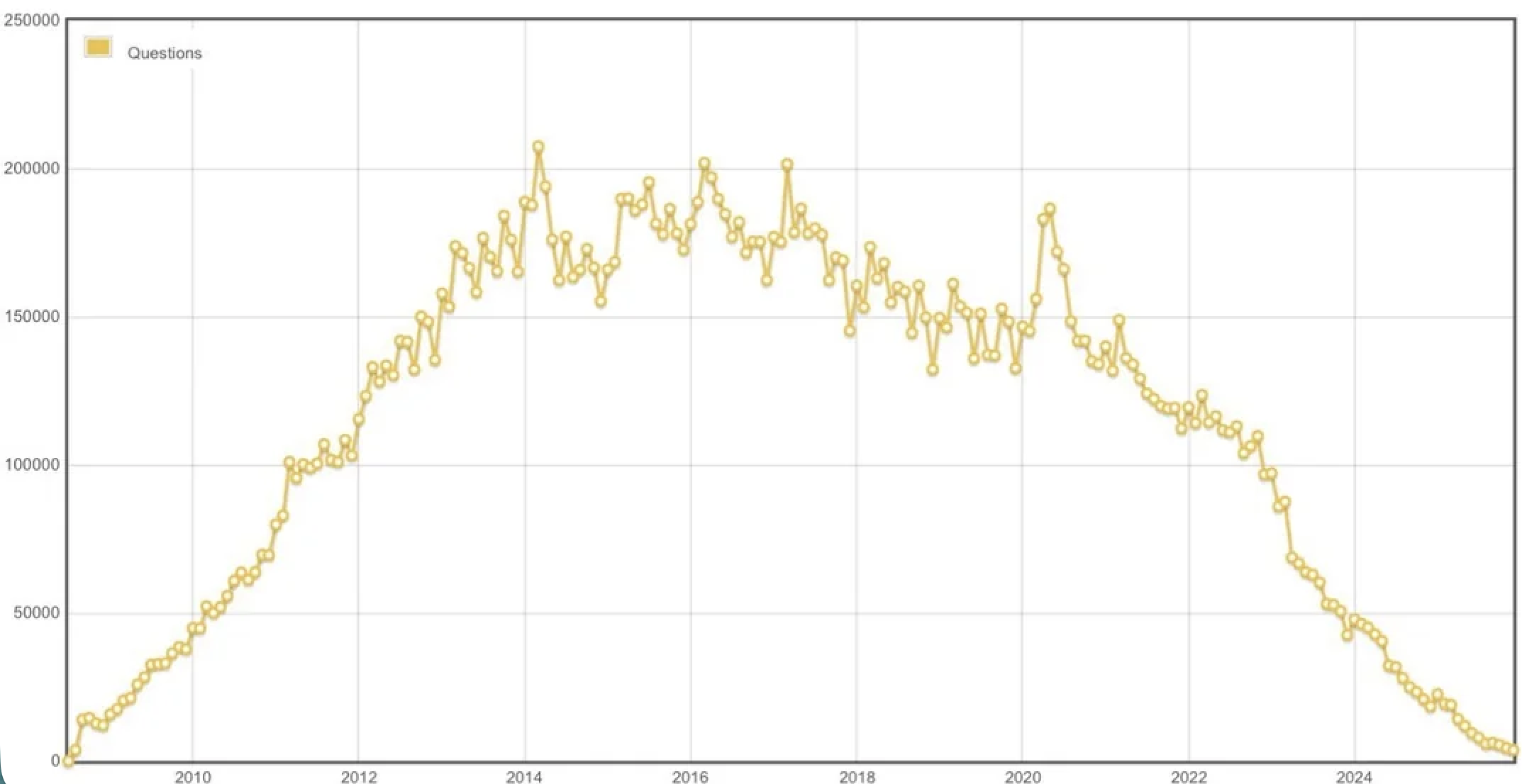
There it is. The graph. The one that makes you squint, zoom in, squint again, and then quietly say “oh”.
Because the surprising thing about Stack Overflow isn’t the boom pre-2017. It isn’t the cliff-face after the launch of ChatGPT. It’s the fact it has been in decline from before anyone without glasses knew what an LLM was.
This isn’t a hot take. This is a coroner’s report.
A Once-In-A-Generation Opportunity
Stack Overflow was absurdly powerful. You’d be able to browse an encyclopaedia of knowledge and learn your developer craft without ever leaving your basement. You wouldn’t just have an answer to your query, you’d have good answers to your queries.
When people got burned by a problem they’d share their solutions. 3 a.m. on your own (crying) because 3 a.m. with a senior dev looking over your work. This was the Encyclopedia Britannica moment of software development. It was untouchable. Right up until it wasn’t.
Wikipedia took decades to fully eclipse print encyclopedias.
Stack Overflow managed to hit terminal velocity in under ten years.
That’s…impressive, in a deeply unsettling way.
It seems like the world is spinning faster, and we’re all getting caught up in the backdraft.
Moderation as the Solution / Problem
Let’s get this out of the way.
Stack Overflow always had abrasive moderation. That was part of the deal. The value proposition was simple:
Ask a question → get a correct answer → move on with your life.
Stack Overflow would build up a database of answers to programming queries that could be used by future generations of programmers. It was a like a Time Machine of goodness.
Yet as time rolled on there was an impossibility of writing a good question. Everything would be closed as a duplicate of something else. If you were working on a commercial project you’d need to be skilled enough to anonymize it (and fast) or be closed down in seconds.
People who were answering questions started to use their power in unhelpful ways.
It was time for a replacement. For something to help with the context of those tricky problems. It was time for the Stack Overflow endgame, but who knew it would be obtained through stealing the best of Stack Overflow itself. No. Not AI.
Speed, faster
From around 2016 onward, something subtle but deadly happened.
Stack Overflow stopped being the fastest way to get an answer.
Google started surfacing:
• Reddit threads
• GitHub issues
• Blog posts
• Random gists written by someone named “dev-final2-complete”
Discord quietly became the place where new ecosystems lived.
Frameworks didn’t say “ask on Stack Overflow”. They said “join our Discord”.
Discord had the killer feature that Stack Overflow could never develop. Nobody got called a noob for making a mistake.
The Killer Blow
And then, of course, came the endgame. LLMs hit the world, and junior programmers chanted in unison “AI told me that it’s over”.
LLMs don’t just answer questions. They answer them:
• Instantly
• Politely
• Without telling you to read the docs
• Without closing your question as a duplicate of something from 2011
More complex questions can be broken down and be sanity checked.
For a huge percentage of day-to-day programming problems, an LLM gives you a Stack Overflow-level answer faster than you can finish typing the title.
LLMs don’t have to be perfect in this respect. They simply need to be good enough and frictionless to help a derv or two out of a hole.
Stack Overflow required effort. LLMs require vibes, and doesn’t hate you for not knowing something it does.
The Uncomfortable Question
Here’s the part nobody seems to want to talk about.
Stack Overflow wasn’t just useful. It was a training dataset disguised as a website. Google monetised this nicely. Now your favorite LLM is using it to digest developers work and make a pretty penny out of doing so.
We’re looking to a SO future where there aren’t going to be those answer. There won’t be corrections, and long-form explanations.
So answer me this. If LLMs keep answering questions based on the golden era does the whole profession fossilise? How are we going to develop new paradigms and more modern ways of doing things? How are we going to develop something better without a basis to work from?
I don’t know the answer. That’s the scary part.
Happy Days?
I think I’m at 45 degrees, and it’s shocking. I’m deep down in this hole. Many developers are relieved that this has happened.
That’s right. They’re happy at the endgame of Stack Overflow.
That’s because their answers are no longer “opinion-based”. Their questions aren’t a duplicate. They don’t have to read some documentation that is wrong.
We might be happy that this is the end of times, but that’s the way things are.
Conclusion
Stack Overflow didn’t die because people stopped caring about good answers.
It died because good answers stopped needing a centralized public square.
That should worry us.
Because once knowledge becomes private, ephemeral, and unarchived, it doesn’t just disappear. It becomes unequal, and impossible for most to access.
History has a funny way of reminding us that convenience is rarely free, and we should let that sink in for a moment.
About The Author
Professional Software Developer “The Secret Developer” can be found on Twitter @TheSDeveloper.
The Secret Developer is in the top 3% of ChatGPT users according to the 2026 “wrap”. Not including work, not including programming agents. Just ChatGPT and worries about their existence. That’s a thing.