
Employees used to be tightly bound to their employers, and the feeling was that if you looked after them and they’d look after you. Why would you ever need to change?
Then Covid changed everything. We are on the downturn of our lives, and tenure is following this trend. Nobody is loyal anymore, and you certainly shouldn’t be.
Disloyal
I used to think looking for another job while happily employed was slightly disloyal, and a bad way to behave.
When you’ve always been paid on time every month, the company meets its contractural obligations and doesn’t do anything overtly bad to you why change? You’ve got the branded water bottle and a half-decent laptop. What more could a software developer possibly want?
The result of this is that your resume quietly fossilizes on your hard drive, and your memory slowly files “interview answers” into your mental toilet.
So when the inevitable happens you aren’t ready. The reorganization. A new boss. The project is cancelled. You cost too much and can be replaced by AI.
Oftentimes you realize that these things are happening just a little too late. You update your resume at 11 p.m. trying to remember how much money you saved the company with your internal tool which streamlined….which process again?
Treating employment as temporary isn’t disloyalty. It’s professional maturity, and preparation for the future.
Your Relationship is Temporary
Companies are constantly in a position to replace you. They have recruiters working on you 2.0 and are prepared to reallocate budgets at the drop of a hat.
One day I went into the office and our project had been canceled. I wondered if I still had a job that day, as our “commercial priorities” had changed and it seemed clear that my relationship with my employer had changed and I needed to wake up. Some people quickly left, and I got reassigned. Nothing bad happened to me.
This time.
I’ve also seen organizational decisions wipe out roles because somebody somewhere decided there was a cheaper way to get the work done (that time the company laid off the whole team). Even when I panicked over being laid off I didn’t learn the whole lesson. That is to always be prepared.
The company always is, and nobody making those decisions says
“We can’t possibly do this. Dave has been really loyal”
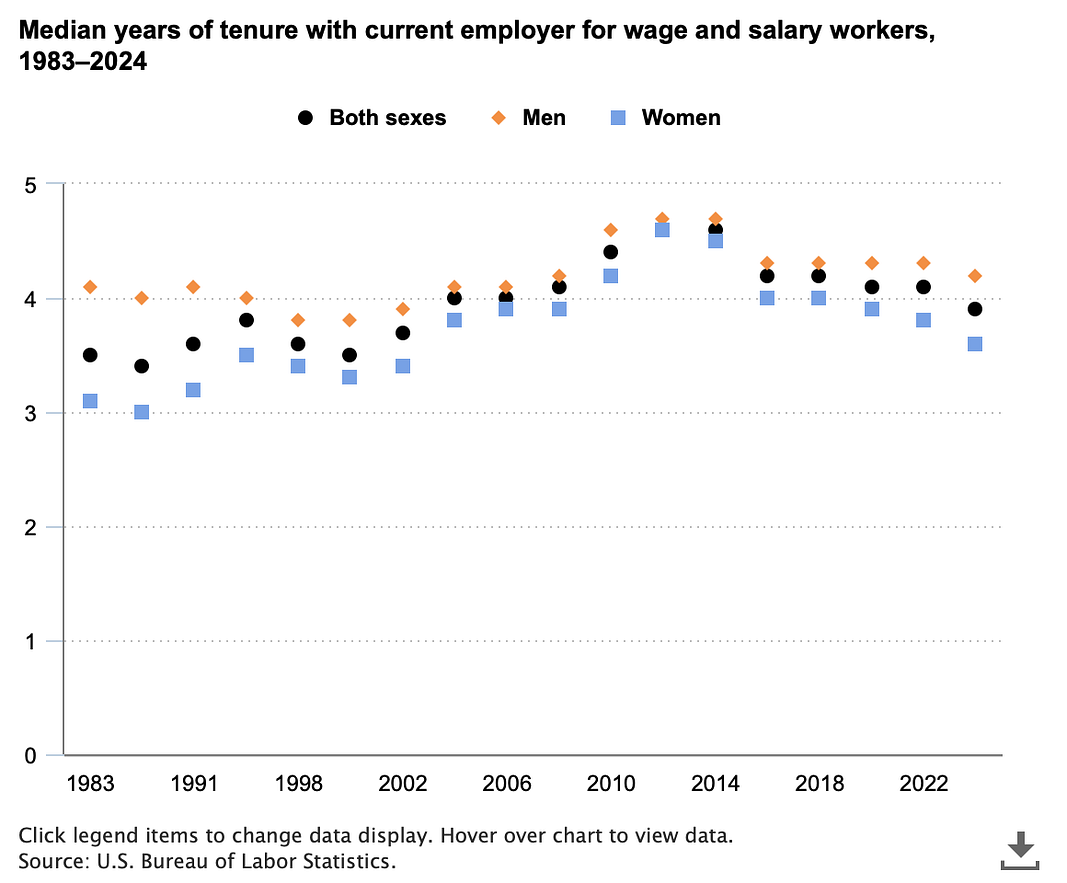
The employment statistics don’t exactly suggest we’re all collecting gold watches either. The U.S. Bureau of Labor Statistics reported that the median employee had been with their employer for 3.9 years in January 2024, down from 4.1 years in 2022 and the lowest figure since January 2002. In the private sector, median tenure was only 3.5 years. (Bureau of Labor Statistics).
That doesn’t mean you should quit at every opportunity. Yet it might just make sense since job hopping gives you greater salary upside.
Your Resume? Never Be Finished
That doesn’t mean you should spend every Thursday evening applying for 47 jobs, because of how exhausting that can be.
I mean you get on something like https://www.indeed.com/career-advice/resumes-cover-letters/guide-to-updating-your-resume (or something not owned by Indeed, which would probably be better).
Because your resume should be a living record rather than an archaeological project you begin after receiving bad news. Each time you get good news from work (a completed project, for instance) you should note it and record it. The metrics, the details.
Each time you mentor somebody, lead an initiative, solve an expensive problem or prevent something horrible from happening in production, write it down.
Do it while you remember. Get it recorded. You’ll be ready to go as soon as you need it. That’s rather less painful than trying to reconstruct two years of work after you’ve been told your position disappears on Thursday morning.
What have I actually achieved recently?
Then you keep it available and ready when that happens.
Happy People Have No Stories
We know tech interviews often don’t resemble the job, and that leads to technical people often saying that they do not need to prepare for the people and behavioral side of interviews at all.
Then we pretend we shouldn’t need to prepare for them.
I’ve certainly learned this lesson the hard way.
Sitting through algorithm trivia can be nothing compared to being asked why should we hire you? In what way are you a technical leader?
Put simply your behavioral stories should already be available.
A difficult stakeholder.
A disagreement with a colleague.
A project that failed.
Something you improved.
A mistake you made.
A time you influenced a decision.
A piece of work that produced a measurable result.
Write them down and periodically practice explaining them.
This isn’t some strange The Secret Developer theory either. Harvard’s career guidance recommends identifying and practicing stories demonstrating competencies such as problem-solving, teamwork, communication and leadership. Indeed similarly recommends preparing examples and practicing STAR responses before interviews. (Harvard Career Services).
Apparently “I’ll just remember all my best professional experiences while being judged by three strangers on Zoom” isn’t the optimal strategy.
Who knew?
Loyalty Should Be Earned
I’m not against loyalty, I’m just for keeping your options open.
Good employers deserve loyalty and deserve you working your best to boost shareholder value in exchange for your paycheck.
Now imagine an employer that trains you, pays you properly, gives you interesting work, listens to you and helps you develop should find it easier to retain you. I say imagine because (of course) these companies do not actually exist.
Yet on the other side loyalty shouldn’t mean deliberately making yourself less employable elsewhere. Like for any project, your career needs to be risk managed. You do that by keeping your resume sharp, keeping the interview stories practiced and keep learning. And if a genuinely better opportunity appears, give yourself permission to consider it.
That’s optionality.
What isn’t optional is your career.
About The Author
Professional Software Developer “The Secret Developer” can be found on Twitter @TheSDeveloper.
The Secret Developer is thinking whether it is time to move on