
The Best AI Prompt Is the One You Never Send
Most software developers I meet these days are terrified of AI.
We are constantly surrounded by stories that our jobs will be gone by the end of 2027 (or make that the end of 2026).
The reality (deep breath everyone) is not nearly so dramatic. While AI is a useful solution for many problems, it doesn’t solve everything. Because it doesn’t understand your business better than you do.
Yet it doesn’t still offer value. But that value sometimes comes before you press enter.
Explaining the Problem
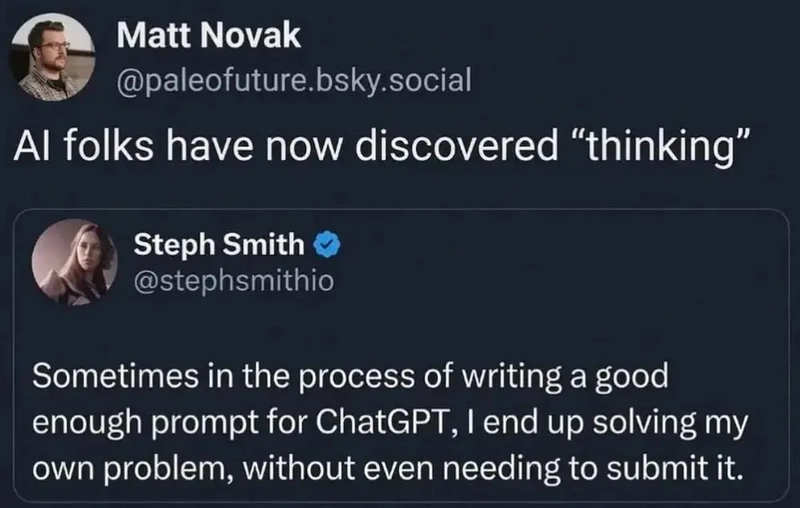
Have you ever started writing a message to a colleague asking for help, only to solve the issue halfway through the explanation?
I have. I think most developers have, been there in the end. You know where.
You spend ten minutes carefully describing the problem. You explain what you’re trying to achieve, what you’ve already attempted, where the data comes from, and what result you expect.
Then suddenly you spot the mistake.
You don’t send the message. Your colleague never knows they almost got dragged into your confusion.
AI tools often work in exactly the same way.
The process of writing a good prompt forces you to structure your thoughts. You need to explain the context, identify assumptions, and define what success actually looks like.
It turns out that many software problems become much easier once you’ve worked out what the problem actually is.
The Real Problem
You can’t admit this happened. You can’t ever (ever) admit that you haven’t solved something in your head near-instantly. Because your colleagues will rate you, and (eventually) hate you.
The real problem in software development is communication.
I’ve just been put onto a new project, and after being added to the Slack group I’ve been on a five minute call to “introduce myself” and then asked “any other questions”? You’d need to give me a minute so I’d be able to know if I’m even likely to have more questions in the future.
It always goes deeper.
Developers receive requirements that aren’t requirements.
Acceptance criteria that aren’t acceptance criteria.
Documentation that hasn’t been updated since the previous CEO.
You spend hours trying to understand what somebody wanted rather than building what they wanted.
The prompt isn’t the solution, and it isn’t the answer. You know why in your heart. The AI hasn’t solved anything yet. You’ve simply been forced to think.
Rubber Ducks Off
Long before AI arrived, developers used something called rubber duck debugging.
The developer would sit in a room, and explain their problem to a rubber duck sitting on their desk. Replace the duck with a dog, partner or wall as you please. It’s all remarkably similar to some meetings I’ve attended FYI.
The process is always the same. It works because explaining a problem forces your brain to organize information differently. You solve the issue, and get everything done.
So AI tools are an expensive version of a rubber duck. They just say “you’re right to push back” at much more frequent intervals.
Which is exactly why we shouldn’t be scared of AI at all. It encourages structured thinking, because a clear prompt requires clear thought.
And perhaps that is what we have been looking for all along.
About The Author
Professional Software Developer “The Secret Developer” can be found on Twitter @TheSDeveloper.
The Secret Developer once solved a problem while writing about solving problems. The irony was not lost.