
The Clout-Driven Exit Strategy
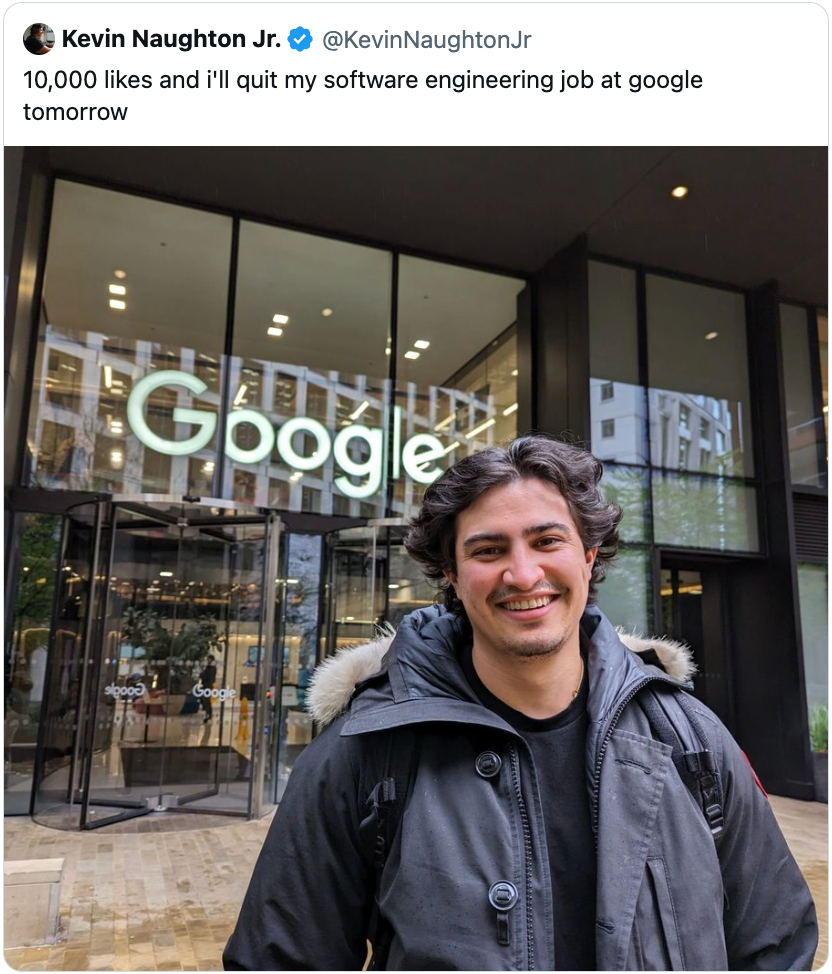
I saw the Tweet, I thought it wasn’t serious. Then I thought it was a business plan.
Then I saw the quality of the content being produced. Its all a joke wrapped up in a business plan.
AI isn’t going to destroy us. It’s people like Kevin.
The Rub
Kevin Naughton Jr. actually tweeted that back in April. He got the 10,000 likes. And he really did quit his software engineering job at Google.
Six months later, he posted:
“Six months ago I made the worst decision of my life.”
The tech world barely blinked.
We’ve seen this script before, and I’m sorry it’s not one that I’m going to follow..
Step 1: Get a job at a Big Tech company. Tell everyone on the internet you got a job at a Big Tech company. Quit. Dramatically. Make a ton of content
Step 2: ????
Step 3: Profit
Kevin is just one more avatar in a growing subculture of software engineers who don’t seem to love writing software. They love talking about writing software. And more than that? Talking about how you can do it too. Just wire $299, payable in three easy installments.
This Is What Happens When You Don’t Love Code
There used to be a joke about actors who really wanted to be famous, not act. We now have engineers who don’t want to build. They want the perks, prestige, and, crucially, the platform. Software is no longer the product.
You are.
These are the people who never cared about writing good code. Astonishing Kevin admits it in this video, but what he doesn’t seem to get is you need to invest in your future to profit. He’s just another one who cares about “career growth”, “impact”, and becoming a “thought leader” and doesn’t care about the code. I can only imagine that their pull requests were sloppy, because why would they care?
The FAANG-to-Funnel Pipeline
Getting hired by a Big Tech company has become less about joining a team to solve real-world problems, and more about credential farming. The job itself is just a stepping stone. The goal isn’t to do the job. It’s to talk about it online until you can quit, write a blog post titled “Why I Left Google”, and pivot to coaching others to do the same.
I’ve worked with people like this. They hoard interview tips like doomsday preppers, but can’t explain the business logic behind their own ticket. They’re on Twitter more than Slack. Their actual engineering contributions? Minimal. But they’re always “building something exciting” on the side, and by that they mean their next brand collab.
You wouldn’t see me doing this. But there again, you’ll see me watching anonomous blog posts complaining about everything.
You Can Smell the Burnout Coming
When you don’t love this work, when you’re just in it for the paycheck, the prestige, or the parasocial validation you’re bound to burn out fast. Not because the work is hard (though it is), but because it’s meaningless if you’re not invested.
So Kevin burned out. Or worse, he never really fired up in the first place. He just followed the script. Got the job. Quit the job. Tweeted the regret. Maybe he’s already cooking up a Notion course on “Finding Yourself After FAANG”. Give it a month.
Do You Actually Like This Stuff?
If you’re reading this and thinking of quitting your Big Tech job to become a YouTuber, coach, or bootcamp bro: ask yourself one question.
Would you still code if nobody ever saw you do it?
Because I would be. I am, and I would continue to do so.
Conclusion
For the sake of those of us who do love it, we’re still here, still shipping, still cursing the CI build that failed for no reason.
Either join us, all in. Or leave us.
About The Author
Professional Software Developer “The Secret Developer” can be found on Twitter @TheSDeveloper.
The Secret Developer seldom gets invited to anywhere, work meetings or elsewhere.