
The Death of Software Engineering (Again)
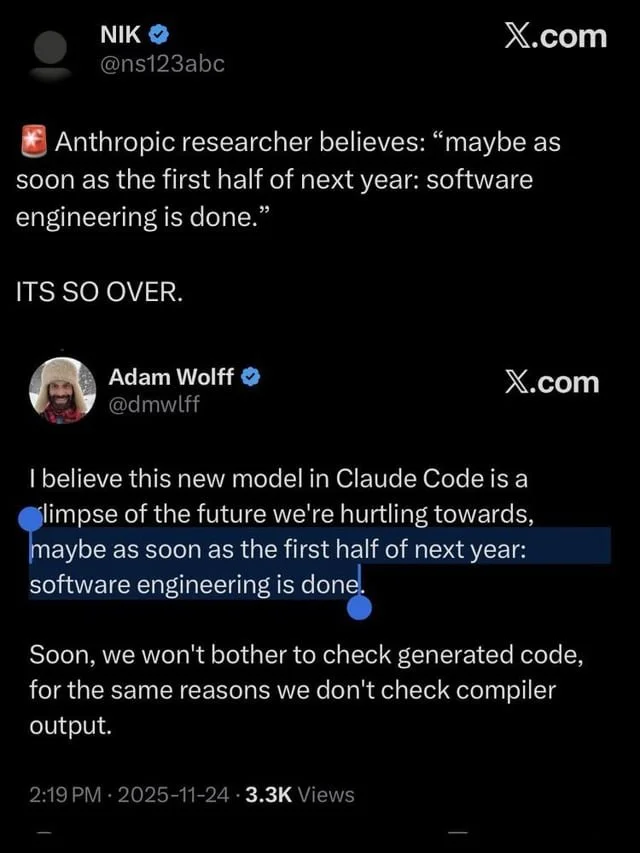
Every few months, the tech world performs its favorite ritual: someone, somewhere, confidently declares that software engineering is finished. Not “changing,” not “evolving,” but done. Fold up your laptops, throw your ergonomic keyboards into the sea, and tell your Jira board you won’t be coming in tomorrow.
And every time, the industry reacts exactly the same way — half panic, half parody, all noise.
The Prophets of Imminent Obsolescence
There is a certain type of technologist who cannot resist a sweeping proclamation. A new model drops, an AI demo looks good on stage, or someone reads one paragraph too quickly from a research summary, and suddenly we’re weeks away from the end of a profession that has survived punch cards, XML, microservices, Kubernetes, and whatever the Metaverse was supposed to be.
The claims always follow the same script:
• It’s over.
• It’s really over this time.
• No, seriously, over.
• Start retraining as a goat herder.
These declarations spread faster than the bug that only appears during a live demo. They’re instantly shared, instantly memed, instantly believed — as long as you don’t read the surrounding sentences or apply even a teaspoon of critical thought.
Engineers Love to Panic
Developers are uniquely susceptible to existential dread. We live in an industry where new frameworks appear more often than bank holiday rain, and we’re constantly told that if we don’t learn them all, we’ll be sweeping floors by Christmas.
So when someone claims that next year — not a distant future, but next year — software engineering is finished, half the industry immediately books a counselling appointment and the other half opens LinkedIn to write a 17-paragraph think piece about “the shifting landscape of value creation.”
Meanwhile, most practitioners are still trying to get CI to pass on a Monday morning.
The Reality Behind the Drama
Despite the melodrama, the actual point being made in these big proclamations is almost always mundane: that generated code is becoming more trustworthy, that tools will continue to automate lower-level work, that developers will move further up the abstraction stack.
This is not the apocalypse.
This is the same trajectory software has been on for fifty years.
Nobody mourns the death of hand-written assembly. Nobody holds vigils for manual memory management in everyday apps. And nobody misses the era when debugging required psychic abilities and an ink ribbon.
Tools improve. Work changes. People adapt. That’s the entire history of computing.
But the Internet Has No Interest in Nuance
Why say:
“Tools are improving and engineering workflows may shift over time.”
when you can instead say:
“Pack it up, nerds, the compiler is your new boss.”
The tech ecosystem is addicted to extremes. Either everything is fine forever, or civilization collapses next spring. There is no middle ground with page views.
The Undying Profession
Here’s the bit that never makes it into the breathless declarations: every time someone claims software engineering is over, the industry goes on hiring again before the ink dries on the hot take.
There will always be systems that break.
There will always be code that needs adapting.
There will always be business logic tangled enough to make an LLM spontaneously retire.
And more importantly, there will always be humans responsible for context, judgement, ethics, architecture, taste, constraints, consequences, and the deeply unglamorous ability to say, “Have you tried turning it off and on again?”
The Real Ending
Software engineering isn’t done.
It isn’t close to done.
It will never be “done” in the way these dramatic pronouncements claim.
What is done — completely, utterly, permanently — is our collective ability to stop declaring the death of software engineering every time a new model lands.
But give it a few weeks.
Someone will announce it again.
And the cycle will begin anew.
About The Author
Professional Software Developer “The Secret Developer” can be found on Twitter @TheSDeveloper.
The Secret Developer hates the “death of programming” cycles.