
Why Your App Depends on a Stranger
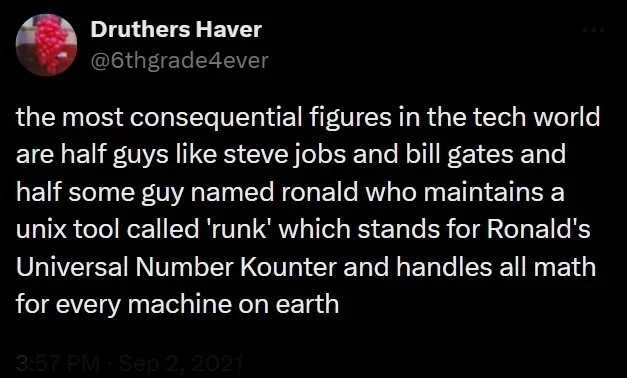
The most important software isn’t AI, and it’s not some tax software you “vibe” coded during a wet Saturday afternoon. Those keynotes with the slick animation aren’t (in the end) important at all.
What is actually important is the stuff nobody wants to think about. It’s the stuff that “just works” and keeps running, all day every day. Rather like employees, it’s the showing up that really counts rather than trying to impress with lies about your “impact”.
One piece of software, and one developer stands out in this quagmire of issues. Sometime before 1986 Arthur David Olson started maintaining a database of time zones.
The Zero Hype Machine
No venture capital. No “vision.” No thought leadership posts about synergy. Solving a problem that exists and you can make a solution for? Nice.
If you’ve never worked with time zones you might be unaware of the issue. Daylight savings rules, countries split across zones, the lack of a single source of truth.
So our friend Arthur created a single source of truth for this complexity. tzdata (or the Olson Database), became the source of truth for a complex system with changing rules. To such an extent that it quietly spread everywhere.
Seemingly any system that needs to know what time it is relies on it.
Maintained by one person.
No redundancy. No corporate backing. No “platform team.” Just someone doing the work because it needed to be done.
And for decades, nobody really questioned it.
Because it worked.
And in tech, “it works” is often the end of the conversation. Your product manager is happy if you ship on time, it’s in production and you move on.
When Someone Tries to Break the World
It’s a happy story when corporate America ends up relying on a single person who doesn’t need to play the game by corporate America’s rules.
Then in steps corporate America who want to put a stop to it. Back in 2011 a company decided that their intellectual property might have been infringed by the database, and threatened legal action.
Arthur didn’t have a legal department to spring to his defence. Nobody to “circle back” and nobody had his back, So Olson announced he was stepping down from a role that paid nothing and lacked even the requisite props for such a project. And no wonder, because defending that kind of lawsuit isn’t something you just squeeze in between commits.
The Panic
The industry realized the obvious.
They were all depending on this.
Not in a “nice to have” way. In a “if this breaks, everything breaks” way.
Time calculations. Scheduling. Logging. Transactions. Distributed systems.
All of it, hanging by a thread.
Something needed to happen, and organizations like the Electronic Frontier Foundation and ICANN stepped in. The legal pressure disappeared pretty quickly after that.
Funny how easy it is to threaten the small guy, but when you’ve met your match your legal threats are the ones that need to “step away” with haste.
Yet maybe the thing that literally every system depends on shouldn’t rely on one unpaid developer?
Yet we are in an industry that relies on unpaid work to function, be that unpaid projects in interviews, providing LLM with the data they need to replace you or the fundamental building blocks of the Internet you never need to look far for unpaid work supporting the capitalist present.
The Real Lesson
We ignore the learnings of issues, incidents and study in tech. Nobody ever seems to care about anything that might matter in the industry, except their own bottom line. Junior positions have always been rare because no company wants to fund the training of the next generation of developers.
This has left us in a world where the most critical parts of our industry are (in no particular order)
Underfunded
Maintained by a handful of people
Invisible until they break
We hate maintaining boring ones, and all the plaudits go to those building something shiny and new.
What seems to be missing is that it’s the most boring ones are the foundation of all the work we do. It’s my experience that teams will argue for days about UI spacing, while at the same time they are more than happy to rely on libraries nobody on the team has ever read (let alone understood).
Everyone seems to assume someone else has it covered. If that’s someone out of the organization nobody really cares.
Occam’s Razor Returns
There’s a principle I keep coming back to. The simplest explanation is usually the right one.
Not everything is a grand system, not everything respects long hours and keep going until something is “solved”.
Sometimes the reason the internet works…is because one person kept a file up to date for 30 years.
And we all just built on top of it.
About The Author
Professional Software Developer “The Secret Developer” can be found on Twitter @TheSDeveloper and regularly publishes articles through Medium.com
The Secret Developer keeps nothing up to date.